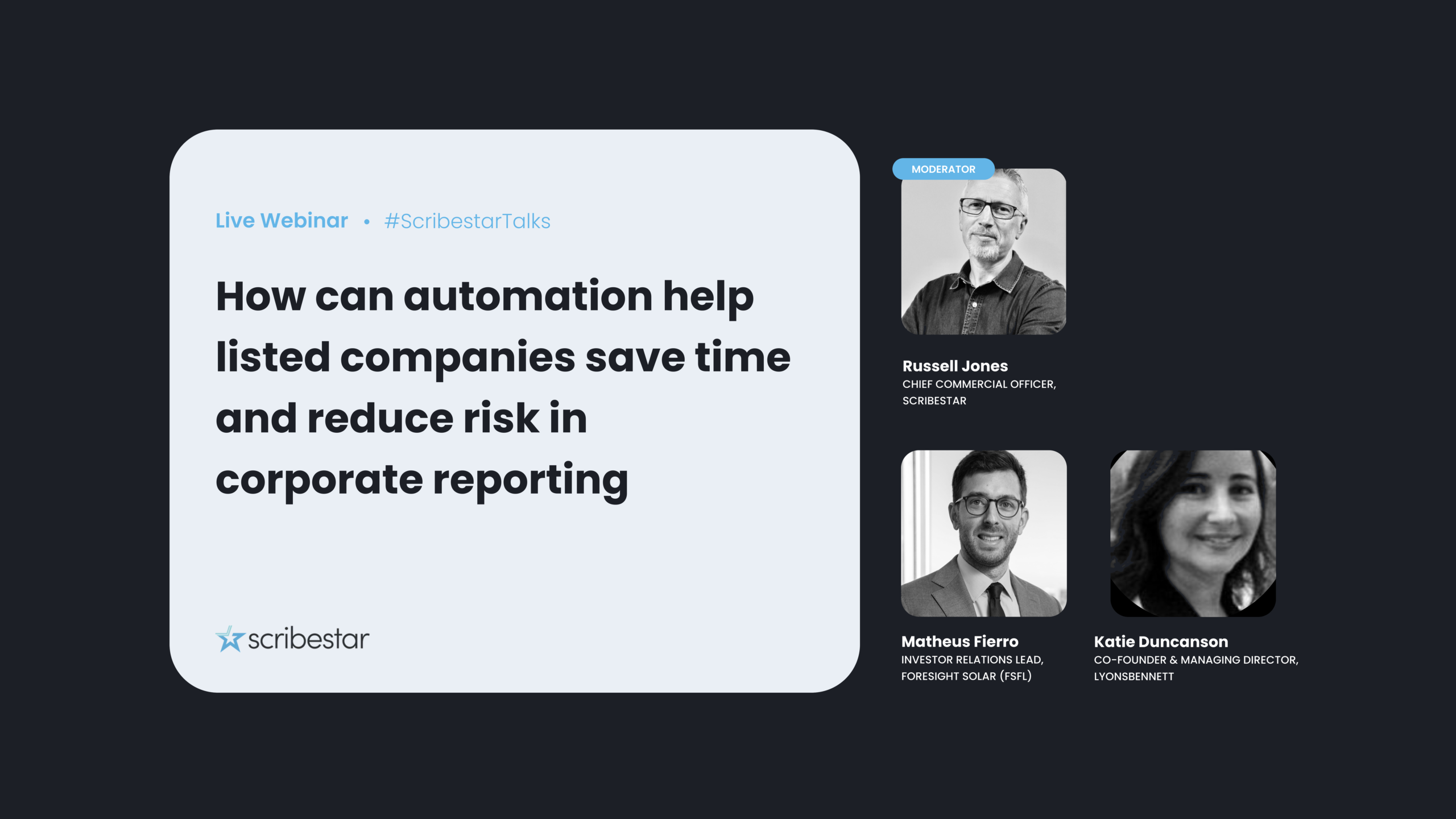
Listed companies are operating in a reporting environment that grows more complex each year. Investor expectations for transparency, evolving sustainability requirements and increasing governance disclosures mean corporate reporting teams are under more pressure than ever. In our recent webinar, speakers from Foresight Solar and Lyons Bennett explored how automation can help listed companies save time and reduce risk while improving the overall quality of their reports.
Why Corporate Reporting Feels Harder Every Year
Annual and interim reports have become significantly longer, more detailed and more scrutinised. Teams must juggle financial data, ESG information, narrative consistency and last-minute regulatory updates—often with limited internal resources. As one speaker put it, “Around 60% of my role is producing reports and making sure all the information is correct.”
Maintaining a coherent narrative across 150–300 pages is another challenge. With many contributors, version control issues and shifting market conditions, even well-planned messaging can become misaligned.
Where Reporting Teams Lose the Most Time
Three areas consistently slow reporting cycles and increase risk:
1. Version Control Problems
Multiple drafts moving between contributors create confusion, duplicated work and the risk of incorrect information appearing in the final document.
2. Audit and Verification Delays
Detailed audit reviews and cross-checking data sources often come late in the process. Manual verification adds pressure and increases the chance of human error.
3. Narrative Alignment
Ensuring the story remains clear and consistent—while also incorporating real-time developments—is one of the most resource-intensive tasks.
How Automation Helps Save Time and Reduce Risk
Automation is proving to be the single biggest opportunity to modernise corporate reporting. Tools that centralise data, manage workflow and streamline verification help teams work more efficiently and with greater confidence.
Key benefits highlighted during the discussion:
- Automated data syncing to update figures across the entire report instantly.
- Controlled access and user permissions to maintain accuracy and accountability.
- Integrated comments and reminders to keep contributors aligned and avoid last-minute bottlenecks.
- Smooth transition from text to design, reducing repagination and layout rework.
The future of corporate reporting is increasingly digital, structured and automation-driven. While narrative and judgement will always require human insight, automation will continue to remove repetitive tasks, reduce risk and give teams more time to focus on meaningful storytelling.
About Scribestar
ScribeStar is purpose-built for corporate reporting, using intelligent automation to improve accuracy, consistency and control. Its linked data, built-in verification and structured workflows remove manual updates and version-control issues—reducing risk at every stage. With a smooth export to design and clear contributor permissions, ScribeStar helps reporting teams save time, work confidently and deliver higher-quality reports without increasing resources.